As a perpetual inventory system, Crunchtime tracks your inventory in real time, providing you with key performance metrics, such as how much product is bought, sold, and thrown away – at any time. Crunchtime also determines the value of your inventory by maintaining a unit price for each product that updates after each new order is received. This guide tells you more about the setting used to determine the unit price, and helps you understand which setting is best for your business.
Keep It Simple
Other accounting methods track the per-unit price of each individual product that comes in, which can make determining the on-hand value complicated and time intensive. Our accounting methods calculate one unit price for each product, making in-the-moment inventory valuation faster, easier, and more accurate.
Add information to the Company Detail screen, delete non–required information from the screen, make and save changes to the screen.
Enterprise Manager
Accounting Method
Accounting Method
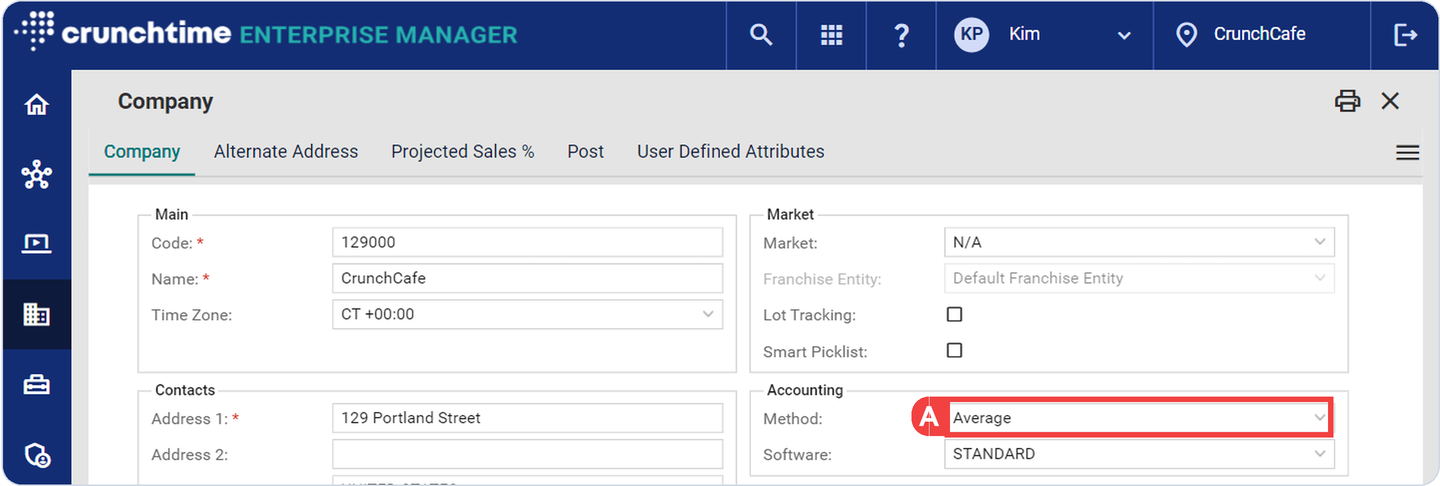
The Accounting Method indicates how Crunchtime will determine the unit price for each product. This setting is used throughout Crunchtime (at every location, for every product) so it is important to choose the option that works best for your company.
Last Price – The unit price of each product is set to the last reconciled price of the product. We recommend this method if your company has contracted pricing for all locations. However, if your company does not use contracted pricing, this method can result in high fluctuations in inventory value.
Average Cost – (Recommended) The unit price of each product is set to the average cost between what is currently on-hand and what has just been received. This calculation is weighted to reflect the amount of product associated with each respective price. We recommend this method because it provides a more accurate representation of the total on-hand inventory value with less dramatic fluctuations.
How It’s Calculated
(Current On-Hand Value + Received Value) / New On-Hand Quantity = Unit Price
Using the Screen
Enterprise Manager > Corporate: Company
A
The Accounting Method setting determines how Crunchtime calculates the unit price for each product. This setting is managed at the Company level to ensure all Locations are using the same inventory valuation method. This setting cannot be edited at the Locaiton level.
A
The Accounting Method setting determines how Crunchtime calculates the unit price for each product. This setting is managed at the Company level to ensure all Locations are using the same inventory valuation method. This setting cannot be edited at the Locaiton level.
Franchise Note
When using the Crunchtime Franchising functionality, Franchise owners can choose the Accounting Method best suited for their operation from their unique Enterprise Manager URL.
Example
Let’s look at how the unit price differs for two nearly identical companies – Company A and Company B – both using Crunchtime to maintain their perpetual inventory. Company A uses Last Price and Company B uses Average Cost.
The Situation:
Each company has 5 apples on-hand, with a unit price of $1.
They then receive a vendor order with 3 apples for $2 each.
How does each company determine the new unit price for apples?
Company A: Last Price
The unit price will be set to the last reconcile price of $2. The total inventory value of apples is now $16 (8 apples x $2 each).
Company B:Average Cost
The unit price is set to the weighted average cost between the current on-hand value and the received value:
Current On-Hand Value = 5 apples x $1 = $5
Received Value = 3 apples x $2 = $6
New On-Hand Quantity = 5 apples + 3 apples = 8 apples
Average Cost = ($5 + $6) ÷ 8 = $1.375
The new unit price is $1.375, and the total inventory value of apples is $11 (8 apples x $1.375 each).